Finance Train LogoFinance Train
Learning LibraryTemplatesBlog
Data Science Bundle
Finance TrainFinance Train
Learning LibraryTemplatesBlog
Data Science Bundle
Lesson 13 of 22

Standard Deviation and Variance of a Portfolio

We learned about how to calculate the standard deviation of a single asset. Let’s now look at how to calculate the standard deviation of a portfolio with two or more assets.

The returns of the portfolio were simply the weighted average of returns of all assets in the portfolio. However, the calculation of the risk/standard deviation is not the same. While calculating the variance, we also need to consider the covariance between the assets in the portfolio. If the assets are perfectly correlated, then the simple weighted average of variances will work. However, when we have to account for the covariance, the equation will change.

Covariance reflects the degree to which two securities vary or change together, and is represented as Cov (Ri,Rj). The problem with covariance is that it has no units, and is difficult to compare across assets. Using covariance, we can calculate the correlation between the assets using the following formula:
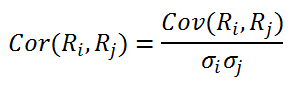
Correlation

After incorporating covariance, the standard deviation of a two-asset portfolio can be calculated as follows:
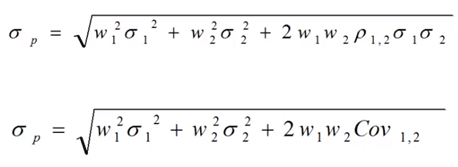
Standard Deviation of a two Asset Portfolio

In general as the correlation reduces, the risk of the portfolio reduces due to the diversification benefits. Two assets a perfectly negatively correlated provide the maximum diversification benefit and hence minimize the risk.

Let’s take an example to understand the calculation. Assume we have a portfolio with the following details:
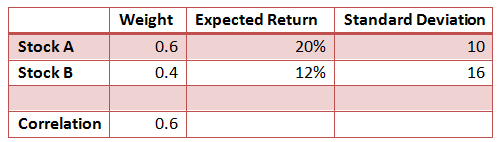
Example

The standard deviation can be calculated as follows:

This portfolio has an expected return of 16.80% and portfolio risk of 11.09%.

Previous Lesson

Calculate Variance and Standard Deviation of an Asset

Next Lesson

Efficient Frontier for a Portfolio of Two Assets

Back to ebook

Portfolio Risk and Return

22 lessons

Lessons

1
Major Types of Return Measures
2
How to Calculate the Holding Period Returns
3
Portfolio Risk & Return - Part 1A - Video
4
Portfolio Risk & Return - Part 1B - Video
5
Arithmetic Returns Vs. Geometric Returns
6
How to Calculate Money-weighted Returns
7
How to Calculate Annualized Returns
8
How to Calculate Portfolio Returns
9
Gross and Net Returns Calculations
10
How to Calculate Leveraged Returns
11
Nominal Returns and Real Returns in Investments
12
Calculate Variance and Standard Deviation of an Asset
13
Standard Deviation and Variance of a Portfolio
14
Efficient Frontier for a Portfolio of Two Assets
15
Effect of Correlation on Diversification
16
Risk Aversion of Investors and Portfolio Selection
17
Utility Indifference Curves for Risk-averse Investors
18
Capital Allocation Line with Two Assets
19
Selecting Optimal Portfolio for an Investor
20
How to Calculate Portfolio Risk and Return
21
Portfolio Risk and Return - Part 2A - Video
22
Portfolio Risk and Return - Part 2B - Video
Finance Train

Learn data science and AI skills for finance through practical courses and tutorials.

Learn

  • Learning Library
  • Course Directory
  • Blog

Resources

  • Templates & Downloads
  • Tools
  • Tables
  • Calculators

Company

  • About
  • Contact
  • Privacy
  • Terms

© 2026 Finance Train. All rights reserved.