Finance Train
Menu

Ebooks / Time Value of Money / Chapter 7 of 13

Present Value of a Single Cash Flow

Securities & MarketsFinancial AnalysisJune 24, 2013 · 1 min read

Present value of a single cash flow refers to how much a single cash flow in the future will be worth today. The present value is calculated by discounting the future cash flow for the given time period at a specified discount rate.

The formula for calculating future value is:
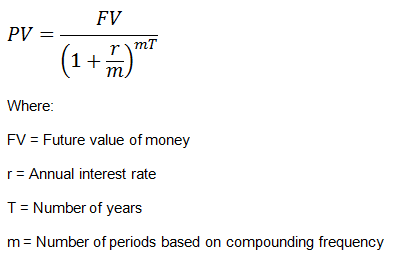
pv1

Example

Calculate the present value (FV) of a payment of $500 to be received after 3 years assuming a discount rate of 6% compounded semi-annually.

FV = 500/((1+6%/2)^(2*3)) = $418.74

We can also solve this problem using the calculator as follows:

In our above example, enter FV = 500, change P/Y = 2 (semi-annual compounding), I/Y = 6, N = 6.

Then press CPT > PV. We get:

FV = 418.74

Check your understanding

5 questions

    1. What does "discounting" a future cash flow mean in the context of present value?
    1. What is the present value of a $1,000 payment to be received in 4 years, given a discount rate of 8% compounded quarterly?
    1. On the BA II Plus calculator, when computing the present value of a semi-annual compounded cash flow with an annual rate of 6% over 3 years, which settings are correct?
    1. As the discount rate increases (holding the future cash flow and time period constant), what happens to the present value?
    1. Which of the following correctly expresses the relationship between present value and future value of a single cash flow?
5 left

Files

  • The Time Value of Money

    PDF · Free