
This article explains how a credit card transaction is process using the example of VISA.
Transaction processing involves the routing of payment information and related data to facilitate the authorization, clearing and settlement of transactions between Visa issuers, which are the financial institutions that issue Visa cards to cardholders, and acquirers, which are the financial institutions that offer Visa network connectivity and payments acceptance services to merchants.
Authorization is the process of approving or declining a transaction before a purchase is finalized or cash is disbursed. Clearing is the process of delivering final transaction data from an acquirer to an issuer for posting to the cardholder’s account, the calculation of certain fees and charges that apply to the issuer and acquirer involved in the transaction, and the conversion of transaction amounts to the appropriate settlement currencies. Settlement is the process of calculating, determining, reporting and transferring the net financial position of our issuers and acquirers for all transactions that are cleared.
Visa transactions can be authorized, cleared and settled either as dual-message transactions or as single-message transactions. The choice of processing method may vary depending upon the issuer, the type of card or the region in which the transaction takes place.
- In a single-message transaction, the acquirer submits a single electronic message containing all data required for the authorization, clearing and settlement of the transaction. Actual financial settlement occurs at a later time.
- In a dual-message transaction, the acquirer submits an electronic message at the time of purchase containing the information required for an authorization decision and a second message at a later point in time containing additional data required for clearing and settlement.
Authorization
A typical Visa transaction begins when the cardholder presents his or her Visa card to a merchant as payment for goods or services. The transaction information is then transmitted electronically to the issuer for authorization. In certain cases, we may authorize the transaction on behalf of the issuer through a service known as stand-in processing, based on parameters established by the issuer. The following diagram illustrates the processing steps involved in a typical transaction authorized through our network. In a typical Visa transaction, the authorization process by Visa occurs in approximately one second.

- The cardholder presents the merchant with a Visa card for payment. The merchant point of sale terminal reads the account number and other data encoded on the card’s magnetic stripe or chip.
- The merchant terminal transmits the card information and transaction amount to the acquirer.
- The acquiring financial institution or its third party processor combines the transaction information into an authorization request message and transmits it to Visa.
- Visa routes the authorization request to the issuer for review. In certain circumstances, such as when the issuer’s systems are unavailable, Visa may perform stand-in processing and review and authorize or deny the transaction.
- The issuing financial institution or its third party processor returns an authorization response message, either approving or denying the transaction to Visa.
- Visa routes the authorization response to the acquirer.
- The acquirer transmits the result of the authorization request to the merchant terminal.
Clearing and Settlement
Clearing occurs at the time of the authorization, for single-message transactions, or in a single daily batch message containing all transactions reported by the acquirer, for dual-message transactions. Settlement occurs on each business day and is conducted on a net basis for all transactions submitted during the previous settlement cycle. The following diagram illustrates the clearing and settlement process between the issuer and acquirer for a typical transaction processed through our system.
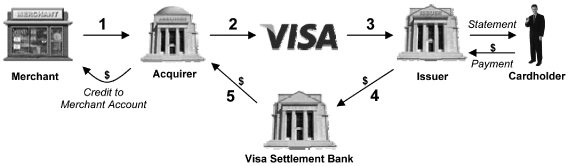
Clearing
- The merchant transmits sales draft information for the transaction, including account numbers and transaction amounts, to the acquirer.
- The acquiring financial institution or its third party processor formats this information into a clearing message, which it transmits to Visa.
- Visa routes the clearing message to the card issuer and calculates the settlement obligation of the issuer and the amount due to the acquirer, net of certain applicable fees and charges.
Settlement
- The issuer sends funds to Visa’s designated settlement bank in the amount of its settlement obligation.
- The settlement bank, at the direction of Visa, transfers funds due to the acquirer.
The issuer and acquirer involved in a typical Visa transaction perform additional functions that is not performed or monitored by VISA. For example, the acquirer credits the merchant’s account for the amount of the transaction less any fees the acquirer charges in accordance with the contractual agreement between the merchant and the acquirer. In addition, the issuer sends a statement to the cardholder and collects payment, in the case of a credit or deferred debit card, or collects payment directly from the cardholder’s deposit account, in the case of a debit card.
Source: VISA Registration Statement filed with SEC.